


 Boiler Bay Beacon

SALEM, Ore. — Oregon’s winter season is shaping up to be a mixed bag, with a mild November giving way to potentially extreme weather in December and January under developing La Niña conditions, state agriculture and forestry officials said Thursday.
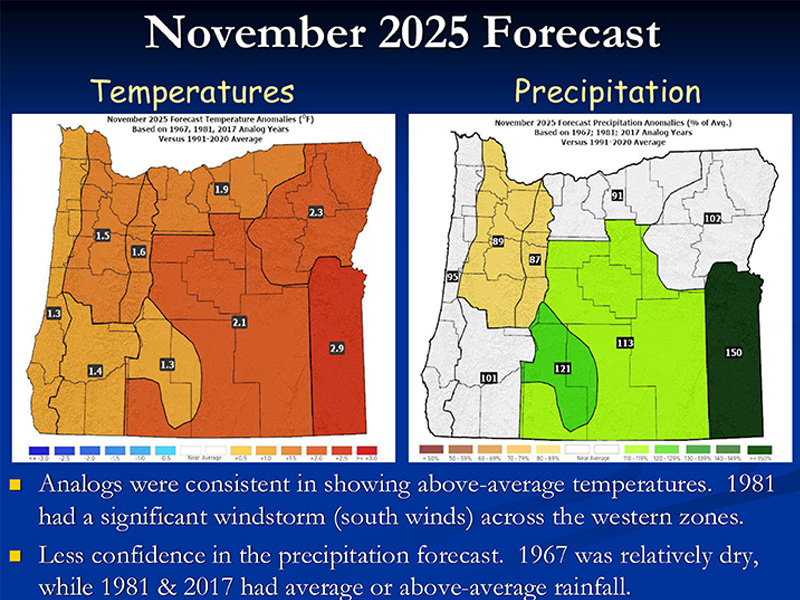
The Seasonal Climate Forecast, produced cooperatively by the Oregon Department of Agriculture and the Oregon Department of Forestry and issued Oct. 16, projects above-average temperatures for November across the state, with near-average precipitation but heightened chances of windstorms in western zones. December and January, however, carry low confidence due to historical analog years showing wide swings, including Arctic outbreaks, heavy snow and coastal storms.

The three-month outlook through January 2026 draws from analog years 1966-67, 1980-81 and 2016-17, selected for matching the current shift toward La Niña — characterized by cooler sea surface temperatures in the tropical Pacific. NOAA’s Climate Prediction Center has issued a La Niña Advisory, expecting the pattern to persist through December 2025–February 2026 before transitioning to neutral.

In November, upper-air patterns favor enhanced southwest flow, keeping conditions warmer than normal while delivering average rainfall in most regions, though analogs like 1967 were relatively dry. December analogs diverge sharply: 1967 had a major coastal storm and Arctic outbreak with widespread snow, 1981 was mild and wet with a significant windstorm, and 2017 was cool and dry. January echoes this unpredictability, with potential for cold snaps enabling rare lowland snow in the west, as in 1968 and 1982, tempered by possible ridging that locks in mildness.

Overall, the blend tilts slightly toward above-normal temperatures and near-average precipitation statewide, but officials caution the average masks risks for farmers and resource managers. La Niña winters historically heighten odds for wetter, stormier conditions in the Pacific Northwest, impacting water supplies, snowpack and fire potential into spring.
“A blend of the analog solutions yields ‘near average’ precipitation, but that is somewhat misleading. Chances for ‘extreme’ events are elevated,” said ODF Lead Meteorologist Pete Parsons, the forecast’s contact and key contributor. Western Oregon faces heightened windstorm threats through December, while mountain snowpack — critical for irrigation — could vary wildly.
The forecast, independent of NOAA’s broader predictions, urges monitoring tools like the U.S. Seasonal Drought Outlook and NRCS snow maps for agricultural planning. La Niña is expected to persist through early 2026 before fading to neutral.
Farmers can subscribe to monthly updates via the ODA website. For more, visit oregon.gov/oda.


