


 Boiler Bay Beacon

EUGENE — A college professor who wants to rescue journalism from catastrophic job losses using philanthropic and taxpayer money has issued a troubling appraisal of media in Lincoln County.
JOURNALISM GURU SAYS RICH DONORS, TAXPAYERS SHOULD PAY REPORTERS

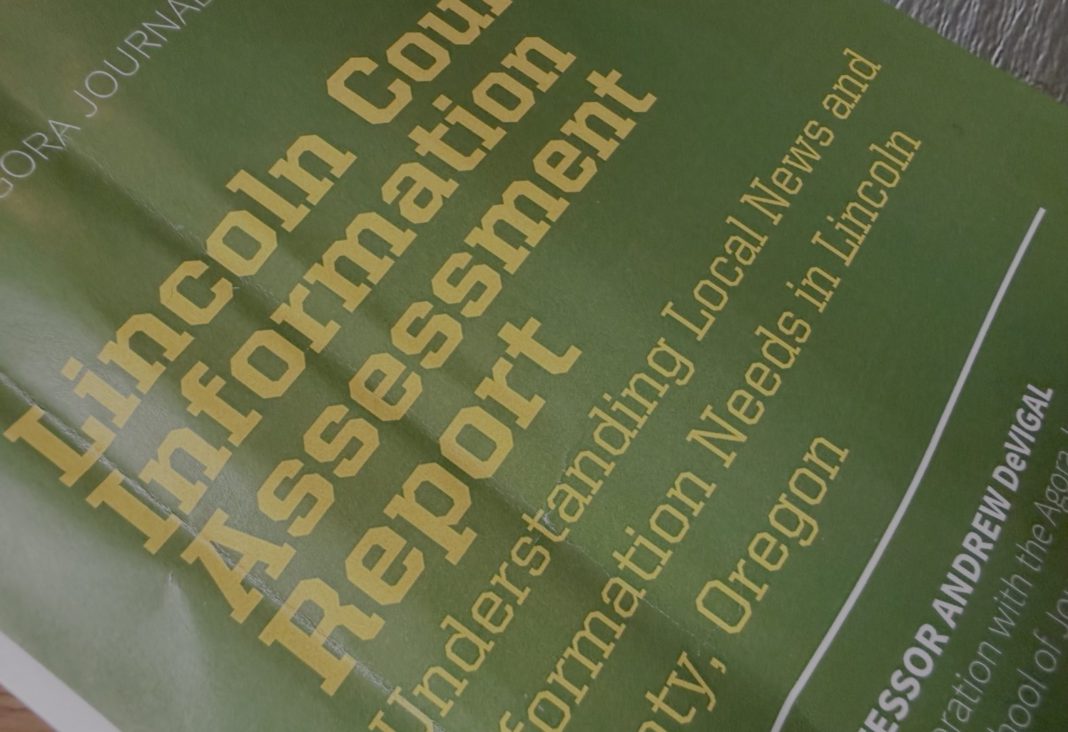
The 54-page “Lincoln County Information Assessment Report” by Prof. Andrew DeVigal of the University of Oregon School of Journalism and Communication describes a shattered “media ecosystem” where legacy news is dead or dying, “fake news sites” abound and wary readers are left to fend for themselves in a daunting new information landscape.
The A.I.-driven study, subtitled “Understanding Local News and Information Needs in Lincoln County, Oregon,” followed a whirlwind round of visits to the central coast by DeVigal that included roundtable discussions in Newport and Lincoln City with 100 local “thought leaders.” A survey the author acknowledged as skewed and statistically unfounded nonetheless bolstered the majority of his conclusions.
A lesson in academic backslaps, the assessment both praised and panned efforts of the Fourth Estate in Lincoln County, writing its “information ecosystem remains active, valued and integral to community life,” but concluding the press is “characterized by fragmentation, uneven access, and deficiencies in trust, coordination and coverage…” In other words, a journalism apocalypse.

Once the backbone of civic life, newspapers large and small from the Denver (Colo.) Post to the Oakridge (Ore.) Dead Mt. Echo and Newport News-Times are dead as Latin. Radio stations that reliably aired school events and emergency bulletins have also pulled the plug, including a five-station Lincoln Co. broadcaster that closed in 2024. A study by Northwest University found that roughly 2,500 newspapers have shut down since 2005 and are closing at a rate of 130 per year with only 1,000 daily papers remaining.
But unlike the “news deserts” he previously explored in Oakridge or the Rogue River Valley, DeVigal discovered a profusion of news sources in Lincoln County, ranging from flashy websites to scrappy social media and government newsletters.
While the plethora of outlets “suggest a diversity of access” to information, DeVigal judged their abundance a “burden” on readers, calling for a centralized source of news to end the clutter — preferably in the non-profit or public broadcasting models endorsed by the report.
Some of the study’s conclusions were based on answers from 787 respondents — about 1.3 percent of local residents — including high school students pressed into the narrowly-circulated survey. Disclaimers stating the canvass was “not statistically representative” and “skewed toward Democrats” did not prevent the use of dubious polling data to criticize some hardworking news outlets including Oregon Coast Breaking News, the central coast’s only female-owned media company with strong U-Tube and FM radio audiences, and the Boiler Bay Beacon, an “internet newspaper” started by two veteran newsmen with around 150,000 readers monthly.
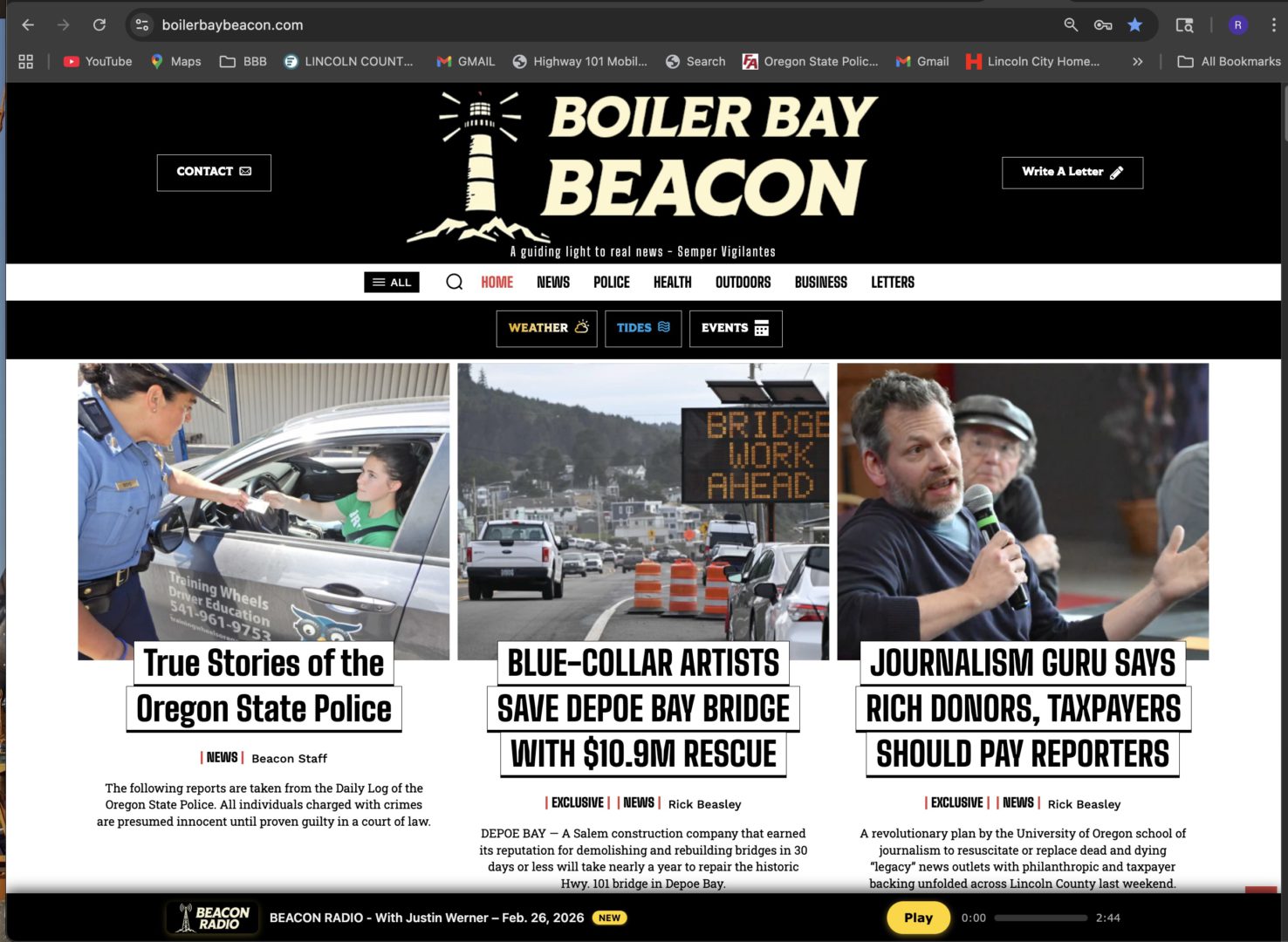
Quoting anonymous survey participants, OCBN was decried for “writing quality, factual accuracy and perceived bias.” The Beacon was disparaged as “having a strong, apparently one-sided editorial perspective…and these dynamics contribute to significant tensions in local discourse.”
The report reserved its cruelest comments for the county’s last broadsheet newspaper, however, calling the Lincoln County Leader “a shell of its former self” and decrying “the paper’s acquisition by a regional chain.” In this unsympathetic analysis, no credit is given to the weekly newspaper’s diligent staff for its century-long service to readers and advertisers, or that for the first time in decades the paper is Oregon-owned.
Devoting a full page to the complaints of nameless respondents, the report labeled the Leader “a declining institution” and called for its replacement with “a local, accountable outlet that respondents would trust and support.” And who could possibly inherit the title of Lincoln County’s leading publication and all the responsibilities for news and legal advertising that label implies?
The non-profit website Lincoln Chronicle, widely deemed the banner of Lincoln County Democrats and one of three “media partners” (including the Lincoln City-based entertainment tabloid Oregon Coast Today and out-of-town Oregon Public Broadcasting) handpicked by DeVigal to survey their followers was declared “the county’s most relied upon local news source” and hailed for its “strongly positive trust profile.” Time and again in the report, the operation is cited as “notable,” “a trusted local outlet,” or the “central component…of Lincoln County’s information ecosystem.”
It turns out the website’s publisher invited DeVigal to examine Lincoln County’s media environment after hearing the journalism guru speak in Florence, initiating a cozy alliance that grew to include enthusiastic delegates from selected media, local government, academia and politics.
With newsroom budgets already stretched tight, some of the survey’s recommendations sound farcically noble, such as filling a reporting “gap” in Siletz (which has a robust tribal newspaper and website) and “expanding multilingual access” for “service and labor sectors.”
“Spanish-speaking residents…constitute a significant segment of the local workforce,” the study argued, albeit without supporting data. “Language and accessibility determine who can participate in civic life and who is excluded.”
The report’s call for “transparent editorial practices” and “clearer sourcing” belied its own use of anonymous quotes throughout the survey, including a prominently featured “34-year-old Siletz female” who alleged the presence of multiple “fake journalism sites…that market themselves as local news when in reality they have no journalism training or ethics.” The reckless comment reinforced the report’s dim view of ethical standards in Lincoln County, reckoning “When money is the motive for news reporting, credibility is gone.”
Instead, DeVigal makes the case for a new journalism, one that abandons conventional free-market funding through ads and paywalls for wealthy donors and government “interventions” to prop beleaguered local news efforts. Journalism jobs have fallen in the U.S. by nearly 35% since 2002, including 6,900 positions between Dec. 2024 and late 2025.
While the notion of government agencies or faceless oligarchs bankrolling the news would have outraged earlier generations of journalists, DeVigal’s own chair at the U of O is funded by $5 million from an anonymous donor and he hopes to raise another $25 million from fat-cat philanthropists such as the Knight Foundation, the Democracy Fund and the Meyer Memorial Trust. Essentially, DeVigal is advocating a shift from independent, adversarial journalism to altruistic “community-centered” reporting where non-profit news, academic and government institutions collaborate to produce a reliable “civic information infrastructure.”
In some respects the 12,000-word report tells us what we already know: governance in Lincoln County — not the media — is the real problem, with citizens including citizen-reporters often denied the ability to attend meetings, ask questions and participate in civic affairs at the entry level.
“Residents reported difficulty accessing information about local government actions, including decision-making processes and opportunities for participation,” stated a key finding in a classic case of understatement.
Is media at the coast a “broken shell of its former self” as this study infers, or is Lincoln County an exciting launch pad for veteran pros, up-and-coming citizen journalists and nascent news businesses finding their way in a brave new world?
Though we read it word for word, we didn’t find the answer in this long-winded report. A mix of academic overconfidence, shameless promotion and doubtful polling, the sometimes mean-spirited narrative felt more like a drive-by shooting than scholarly inquiry.


